How do business decisions shape the housing crisis — and potentially, its solution?
29 January 2026

This Explainer unpacks the different roles that business actors play at every stage of housing development, and shows how a responsible approach to housing based on accountability, participation, transparency and non-discrimination means investing in stability, trust, and shared value. The Explainer makes a case for why ethical business is also smart business by drawing on examples from Spain that are applicable in other countries.
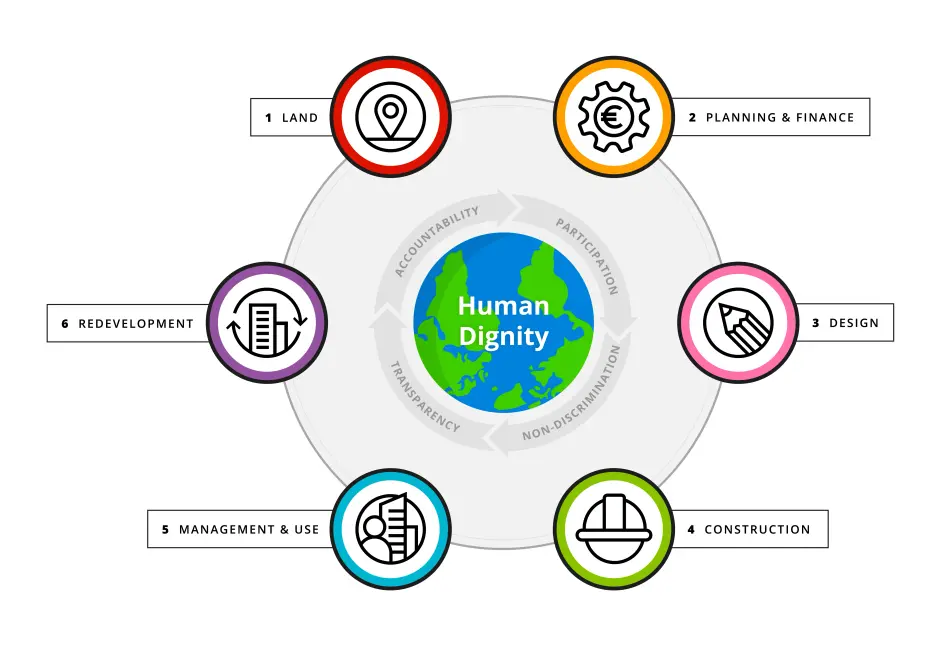
The Built Environment Lifecycle - IHRB
What is the social impact of the housing crisis?
The housing crisis facing most advanced economies is fundamentally rooted in the lack of access to adequate housing. It has become very difficult to find a home that is affordable, well-located, in habitable conditions, that satisfies accessibility needs, is safe from the effects of climate change – and from which tenants do not fear being evicted.
All EU Member States hold legal obligations to protect the Right to Adequate Housing because it is enshrined in Article 11 of the International Covenant on Economic, Social and Cultural Rights. The UN Guiding Principles also sets out principles for companies to prevent, address and remedy human rights violations, including violations of this right. But, homes are often treated like commodities rather than human rights, leading to decisions across the housing value chain that undermine families’ capacity to access adequate housing.
However, housing can be a powerful engine for social wellbeing, sustainability, stability and prosperity: if people can live in affordable, energy-efficient homes near schools, transport, and care, their lives improve dramatically. And if the construction sector offered more stable jobs with pathways for growth, hundreds of thousands of workers could build better futures.
This transformation won’t come from policy alone — it requires a shift in how businesses operate at the different stages of housing projects.
1. Land: Hoarding versus unlocking access to inclusive and affordable housing
Land is a critical element of any housing project. Its location shapes residents’ access to essential services and opportunities such as healthcare, education, jobs, and public space, and it has the greatest influence on housing prices. Developers and landowners acquire land, sometimes years in advance. Urban planners and local governments decide what can be built and manage the necessary permits to do so.
When housing is treated purely as a commodity, land is often banked and kept vacant until it can be resold for a profit instead of being developed to meet real housing needs. A rights-based approach to land development opens up possibilities for collaboration between landowners, developers, and public authorities to unlock well-located land for inclusive housing, with shared investment in infrastructure and community services.
A clear example is Barcelona’s 2021 framework agreement (Conveni ESAL), under which the city cedes public land to housing associations and cooperatives to develop. In return, these deliver affordable homes for people priced out of the market, while land ownership remains public. In five years, this model has enabled the development of almost 20 plots, with 700 homes underway and 300 more planned. Projects include Binèfar by developer Fem Ciutat; Can70 by Sostre Cívic; or Les Palmeres by Fundació Nou Lloc and Fundació Salas, among others. Sixty percent of projects are affordable rentals and 40% are cooperative housing, all delivering strong social and environmental benefits.
For developers, this transparent and cooperative use of land reduces legal and planning risks, avoids reputational harm, and secures high-quality, long-term development opportunities. |
2. Planning and Financing: Accelerating exclusion versus investing in sustainable housing
Finance determines what kind of housing gets built. Before construction begins, developers must secure permits and capital, usually asking for loans that they complement with their own capital. Banks and investors assess risk, timelines, and expected returns. Public authorities can influence these financing decisions through loan guarantees, usually when projects contribute to affordability and sustainability objectives. Lenders pay out loans as construction progresses, which are then repaid over time through the sale or rental of the completed homes.
Under a speculative logic, the capital raised is channelled toward short-term profit: luxury developments, tourist accommodation, or lightly regulated projects that promise quick returns. This approach fuels price volatility and ignores long-term housing needs, displacing communities and triggering social unrest.
A rights-based approach, by contrast, aligns developers, financiers, and municipalities around stable, socially useful outcomes. In turn, allowing to create innovative financial mechanisms that unlock sustainable and affordable housing construction and retrofitting. While also promoting business resilience by building housing types that meet the needs of local people, not of global investors or short-term visitors, shielding investors from global shocks to human and capital mobility.
Development banks like the Instituto de Crédito Oficial and the Institut Català de Finances have opened dedicated financing streams to develop impactful housing projects. These are backed by the recent investments by the European Investment Bank and the Council of Europe Bank, demonstrating the appetite for adequate housing investments in Spain. Commercial banks like Triodos now offer green mortgages to clients, while Kutxa Laboral has developed a funding package for communities to promote retrofitting, funding both accessibility and energy efficiency upgrades. Private lenders are also innovating to promote socially inclusive retrofits: the Spanish Green Finance Institute is working on Property Linked Finance; Ecrowd has developed GIDOMUS to allow people to invest their savings directly on retrofitting projects. Altogether new business models are also emerging: ALAS or TuTechô have been created this year as “positive impact real estate investment trusts” with the objective of raising private capital in the stock exchange to fund socially and environmentally sustainable housing projects. While Omplim offers investors who want to invest in sustainable and socially inclusive real estate managing their capital to develop such housing projects.
Long-term housing investments are less volatile, earn public trust, open space for financial innovation, and are increasingly supported by public incentives, ESG finance tools and impact investors. |
3. Design: A tool for exclusion versus a blueprint for building with dignity
Developers work with architects to decide how many homes to build, their size, quality, and target residents. Their work sets the future conditions of liveability: layout, materials, accessibility, and energy systems.
Design can be used to deliver a minimum aesthetic appeal that hides poor quality of materials, construction, and in general, habitability. It can exclude older people and those with disabilities, make people vulnerable to volatile energy bills or make homes unfit for the changing climate. In time deficiencies show and can undermine the reputation and future business opportunities of all actors involved. Moreover, a focus on short-term profit can lead to sourcing materials without visibility of the supply chains they come from, risking indirectly partaking in forced labour. On the contrary, centering rights in design decisions allows making the most efficient use of resources, with the least environmental impact and delivering the highest quality, also for affordable housing. While seeking transparency in materials’ supply chains can unlock shorter supply paths, promoting local prosperity, reducing transport distances and alleviating the impacts on the environment.
Design and construction company 011H has developed an integrated platform to source prefabricated and sustainable building elements for affordable homes that are energy efficient and other housing projects. Similarly, energy company EOS and construction company ZENIT have created EOSZNENIT, a streamlined platform for designing and promoting energy efficient retrofitting without upfront payments from residents. Energy monitoring firm Arkenova combines technology and building residents’ knowledge about energy use to include the most efficient energy systems for each building design, monitor and lower consumption.
Centering design decisions on meeting residents’ needs improves habitability, lowers maintenance costs and improves residents’ sense of belonging, while helping meet growing legal requirements for energy and accessibility and safeguarding long-term demand. |
4. Construction: Cutting corners versus building for the long-term
Developers hire construction firms, who turn plans into buildings. Contracting determines workers’ rights, while choices of materials and building practices shape durability and safety.
When a speculative logic dominates, low wages, unsafe conditions, and cheap materials result in poor housing and vulnerable jobs. In the worst cases, with fatal consequences; in general, facing climate-enhanced health risks. While opaque subcontracting can further erode the dignity of already marginalized populations, especially migrant people. As a consequence, firms opting for this logic will find it hard to attract and retain talented workers in a sector marked by stark labor shortages.
In contrast, firms can invest in safe workplaces, fair pay and training to use new materials and implement new practices that lower costs and environmental impact. Combined with a business strategy based on constructing a larger volume of affordable and sustainable housing (in contrast to fewer, more expensive units), this approach has allowed Grupo Salas to become one of Catalunya’s largest developers. Other construction companies like Calaf Constructora or Arcadi Pla S.L are also tapping into the business opportunities brought about by the development of affordable and sustainable housing projects that housing associations and public institutions are developing. While companies like CEVASA or VISOREN have grown steadily for the past two decades by explicitly focusing on building affordable public housing for rent (Viviendas de Protección Oficial para alquiler).
Moreover, construction can also create opportunities for empowerment and labor inclusion. Straddle 3 and IDRA have developed Wikihousing, a capacity-building initiative that teaches people to build houses through direct participation. Firms exploring inclusive approaches to industrialized construction –whereby the elements of a housing project are produced off-site in a factory– can create good construction jobs for people historically under-represented in construction, like women.
Quality, well-paid jobs reduce accidents and turnover; higher-quality builds mean fewer lawsuits and stronger client relationships; and an explicitly social vision opens up new opportunities for stable business growth grounded in the prosperity of the territory. |
5. Management & Use: Extracting value versus sustaining communities
Once built, housing is sold or rented, and managed over time. Real estate agencies, landlords, property managers, housing associations or cooperatives, depending on the type of housing, handle maintenance, resident relations, and rent levels.
When management prioritises rent hikes, short-term rentals, and rapid turnover, long-term tenants are pushed out, hollowing out communities. Furthermore, an excessive focus on short-term profit leads to postponing investments in maintenance, aggravating houses’ inadequacy, including to climate change.
On the other hand, managers who maintain properties well, ensure rent stability and support long-term tenancies reduce vacancy and turnover costs, protect asset value and favour community cohesion. Sogeviso, a housing management company created by Banco Sabadell, has vowed to manage the bank’s rental housing portfolio based on socially responsible criteria, providing conflict resolution and mediation mechanisms to avoid the eviction of families. Housing associations like those represented by the federation COHABITAC often stress the importance of providing social and health support as part of their housing management duties, as these are key to residents’ inclusion and fostering stable and prosperous communities.
Housing management can also create opportunities for direct social participation, something increasingly valued by cities and funders. Social participation can allow housing managers to increase the efficiency of their maintenance investments. Housing association Fundació Habitatge Social invests in building the capacities of renters to make a more efficient use of energy and evaluating energy improvements directly with them, so changes are made when needed –e.g. switching A/C machines that were not being used due to high bills for ceiling fans, that also improve ventilation issues reported by residents.
Housing management that balances maintenance, rent stability, and social support strengthens communities, reduces costs, and protects assets. Engaging residents in decision-making fosters inclusion and improves the efficiency of maintenance interventions. |
6. Redevelopment and Retrofitting: Gentrifying versus protecting communities from climate change
Redevelopment and retrofitting aim to modernise existing housing — either through demolition and rebuild, or upgrades to insulation, ventilation, energy systems, and structural reinforcement. Redevelopments are usually led by developers and investors. Retrofitting may too, although it’s typically homeowners who decide to invest in upgrading their homes.
When redevelopments prioritise an asset’s increase in value over social stability, they generate displacement through gentrification. Moreover, demolitions have a great environmental impact. Hence the importance of deeply evaluating the need for redevelopment against the possibility of retrofitting. When redevelopment is indeed necessary, approaching them from a rights-based perspective creates opportunities for labor inclusion and circularity. Innovative company Recursos Urbans trains and hires people to recuperate reusable materials from demolition sites, that can be then used in other housing projects.
Similarly, retrofitting can be used to justify rent hikes or evictions, displacing vulnerable residents. But it can also be used to improve the adequacy of homes and lower energy bills, which can drastically improve the quality of life of families with the least resources. This is particularly important in relation to families living in rental housing, which also tends to include the houses that perform the worst in terms of energy efficiency. Thus, finding ways to retrofit energy inefficient housing without increasing costs for tenants has a multiplier effect: conveying both a large social and environmental impact.
Public authorities are increasingly aware of this leverage and are providing increasing support for inclusive retrofitting, helping generate more business volume. Through these public-private collaborations, housing associations like Hàbitat 3 have specialised in finding empty homes, guarantee rental payments to owners, upgrading the homes for energy efficiency, and then renting them out at social prices to people in waiting lists for public housing. In only ten years, Hàbitat 3 has gone from zero to 848 retrofitted apartments. Moreover, when possible, retrofits have been done through labor inclusion agencies like Projectes Mansòl, training and hiring people facing social exclusion. In Catalunya, the Canary Islands, Euskadi and Navarra, Provivienda is working with governments to directly leverage energy efficiency subsidies to incentivize owners of empty apartments to cede them, after which Provivienda retrofits the homes and rents them at social prices.
Focusing on residents’ rights in redevelopment and retrofitting protects neighbourhoods and thus future opportunities, secures public support, and creates sustainable financial returns through boosting tenant relations. |
Can business decisions across the housing value chain trigger a chain reaction for good?
Every business actor in the housing value chain makes decisions that either exacerbate the crisis or help overcome it.
A rights-based approach means looking beyond short-term profit maximization, aligning economic success with social value and consequently, guaranteeing long-term financial performance. For residents, it means adequate homes. For workers, it means better jobs. For cities, it means livability. For businesses, it means relevance, resilience, and long-term success.
The majority of practices highlighted in the Explainer are led by partners engaged in the Built Environment Just Transitions Accelerator in Spain. Reach out to learn more and explore opportunities to accelerate mainstreaming sustainable and fair business practices in housing projects.
Do you want to know more?
- Read IHRB’s report “Advancing Just Transitions” to know more about inclusive approaches to housing sustainability
- Use the Dignity by Design Framework as a tool to center a rights-based perspective in your housing projects
- Discover IHRB’s Built Environment Just Transitions Accelerator, working across Denmark, the UK and Spain


